Some places feel familiar as soon as you arrive. Others take a bit longer to get to know. Piedmont is one of those.
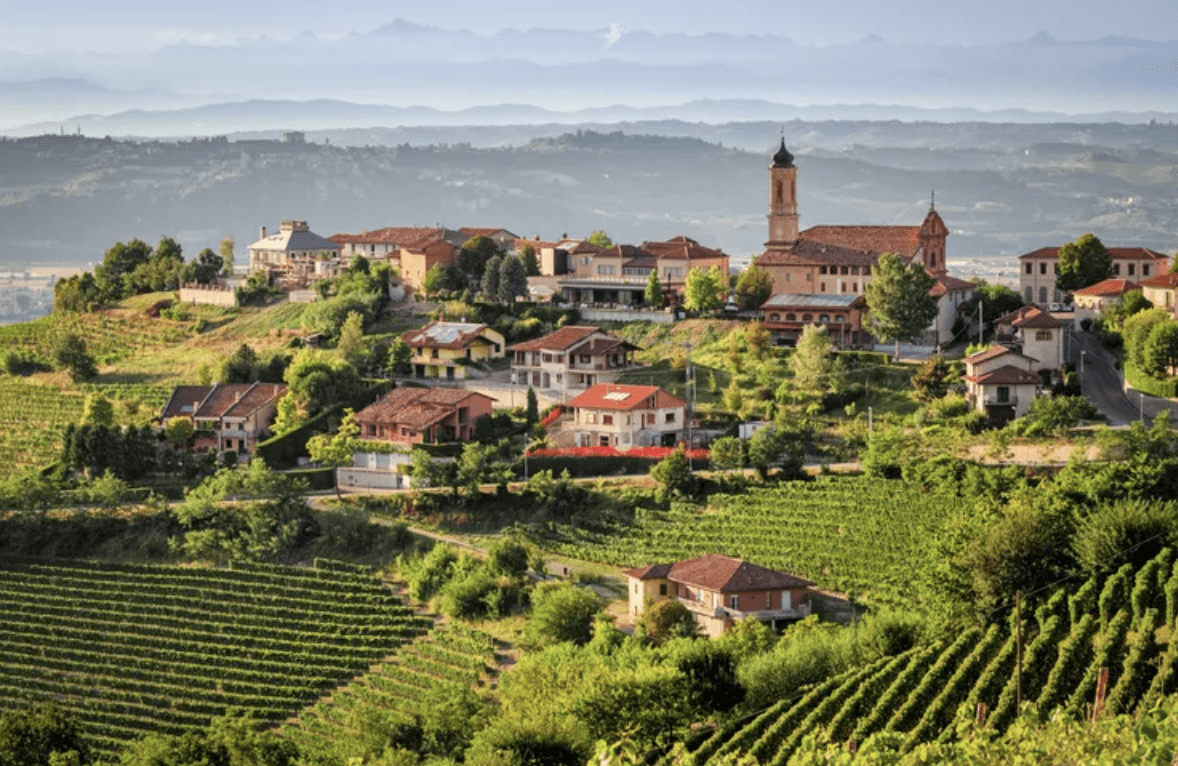
It sits in the northwest corner of Italy, pressed up against the Alps, with hills that fold into each other in a way that feels endless. The name means “foot of the mountains,” but that doesn’t quite capture it. There is a sense of scale here, but also a kind of quiet. Nothing about it feels rushed, and the wines reflect that.
Piedmont used to be underwater. An ancient sea once sat where the vineyards are now, and as it receded, it left below layers of limestone, clay, sand, and fossilized material. You can feel that history in the wines. There is structure, but also something lifted and almost saline at times, a kind of tension that makes you pay attention. The soils shift constantly, even within a single hillside, and that variation shows up in the glass in ways that are hard to describe until you’ve tasted it side by side.
Fog plays its part too. In the fall, the vineyards are often covered in a thick morning haze that slowly burns off as the day goes on. It softens the light, stretches the growing season, and gives the region a certain mood. Nebbiolo takes its name from that fog, and it feels fitting. It is not a grape that reveals everything right away.
Nebbiolo is often the headline here, and for good reason. It produces wines that carry body and finish, as well as detail. There is something layered about it. You take a sip, and then you take another, and then you start to notice what’s underneath. It is not about impact, it is about presence.
But if you stop there, you miss a lot of what makes Piedmont so enjoyable to drink. Barbera has a different kind of energy. It is bright, a little more immediate, and often the bottle that makes the most sense on a random Tuesday. Dolcetto leans softer, a little more relaxed, but still grounded in place. These are the wines that show you how people actually drink here. Not everything is saved for later.
There is also a side of Piedmont that doesn’t get talked about enough. Arneis can be textured and slightly wild in a method that feels very true to the region. Cortese, especially from Gavi, is more restrained, with a clean line that makes it incredibly versatile at the table. These wines don’t ask for attention, but they reward it.
Historically, this place has always been closely tied to the land. Before it became a destination aimed at collectors and wine lists, it was simply a region where people farmed, cooked, and drank what they made. The move toward more structured, age-worthy styles came later, and even now, there is an equilibrium between tradition and evolution. You see it in the cellar, but you also feel it in the way the wines are meant to be shared.
Because what ties everything together here is that these wines make the most sense on the table. a plate of pasta, a few people, bottles being passed around. The structure of the wines supports the food, but it also supports the moment. Nothing feels out of place.
That is something we often come back to when choosing wines for the shop. We are not only thinking about what is considered important or collectible. We are thinking about how a wine fits into someone’s life. Whether it feels like something you would reach for again, or something you would want to share.
Piedmont has a way of staying with you. Not because it tries to, but because it feels grounded in something real. The landscape, the history, the way the wines unfold over time. It all adds up to something that does not need much explanation.
You just have to spend a little time with it.

